
How to read this guide: the inspection sequence is our editorial method. Brand-specific facts link to their manufacturer. It is a way to document a candidate, not an authentication or valuation service.
01 / Start with what is there.
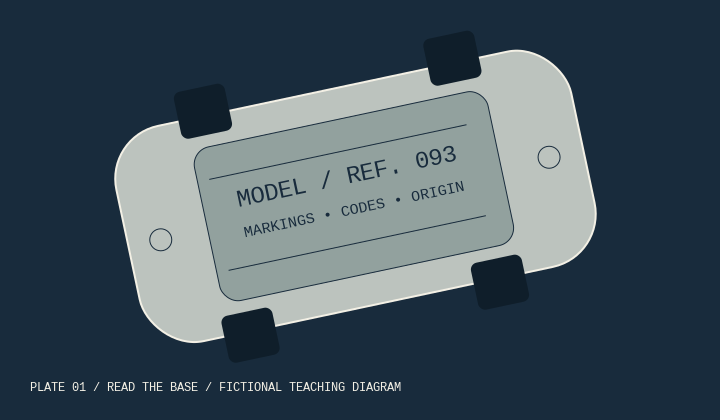
Place the model on a plain surface with enough light to read small markings. Before looking for a match online, write down what you see. This keeps an attractive search result from deciding the answer for you.
- Copy the markings exactly.Record the brand, model wording, any scale marking, country wording and each code as separate fields. Preserve unusual spacing or punctuation in your notes. Use “unreadable” where a character cannot be resolved.
- Describe the visible configuration.Note body colour, printed decoration, wheel design, window tint, interior colour and base finish. Record visible changes or damage separately so they do not quietly become identifying features.
- Connect the packaging carefully.If a box or card is present, photograph its front, back and end labels. Record the printed product code. Treat a loose car and a separately obtained box as two objects until their relationship is supported.
02 / Keep the dates separate.
For Hot Wheels, Mattel explains that Showcase uses the on-shelf release year, while the stamped year usually relates to the casting’s first year. A base year alone therefore does not establish the release you hold. Source: Mattel Showcase FAQ · checked 27 September 2026.
| Record | Question to answer |
|---|---|
| Text on the model | What date or code is actually visible? Transcribe it before interpreting it. |
| Candidate release | Which documented product listing matches the visible configuration? |
| Your observation | When did you inspect this object? Keep that date distinct from a release date. |
Our recommendation: store the raw marking and your interpretation in different fields. If a production code has no verified manufacturer explanation, leave its meaning unresolved rather than borrowing another brand’s decoder.
03 / Compare one detail at a time.
In Mattel’s Showcase terminology, variants share release year, series, casting and body colour; differences can include wheels, windows, interior, base, origin or printed decoration. This is an app-specific definition. Source: Mattel’s variant definition.
Use a comparison grid for your own candidate. Put the observed detail beside the reference detail and the source URL. “Matches,” “differs” and “not visible” are more useful than a single confidence score with no explanation.
- Body: compare shape, openings, trim and decoration placement.
- Wheels: record the pattern and apparent colour on both sides.
- Base: compare wording and finish, preserving the raw code.
- Evidence gap: explicitly note any reference view that is missing.
A difference is a reason to investigate. Your next step may be another source or a better photograph; do not jump from an unusual detail to a claim of rarity.
04 / Give every side a view.
Our six-view photo plan covers front, rear, left, right, top and base. Keep the background and light consistent, then add close-ups of small markings and anything that differs from your reference.
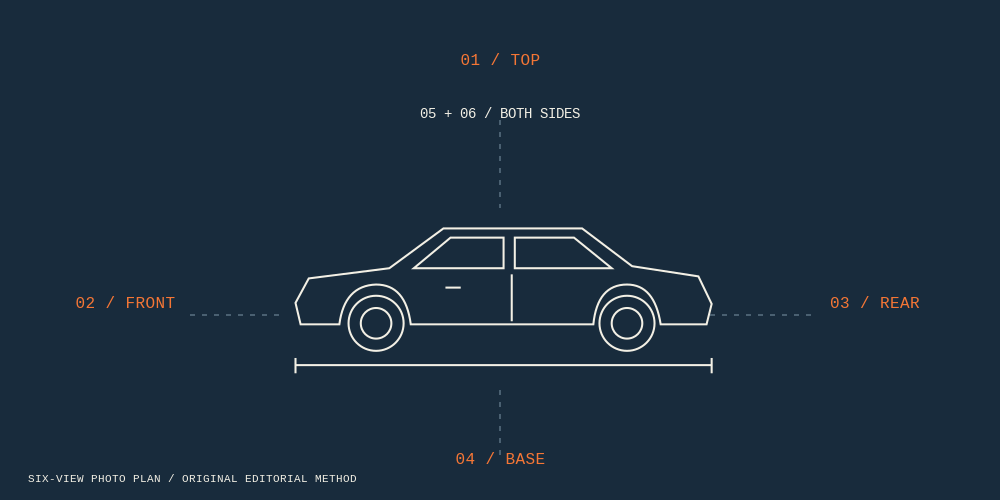
Include a ruler in a separate measurement photo, aligned with the dimension being recorded. A perspective photograph alone is not a reliable length measurement. Give each image a stable filename that you can cite in the worksheet.
05 / End with a traceable record.
Write the candidate name, the best matching source and the remaining unknown in a short conclusion. A useful record can say “candidate identified; wheel variation unresolved.” You can improve it when better evidence arrives.
Keep observations distinct from seller descriptions and your own inferences. Our workbench provides a single local worksheet with separate fields for those notes and a downloadable copy.